<?xml version="1.0" encoding="utf-8"?>
<feed xmlns="http://www.w3.org/2005/Atom">
<title>PN Posch</title>
<subtitle>Writing by Peter N. Posch.</subtitle>
<link rel="self" href="https://pn.posch.org/atom.xml"/>
<link rel="alternate" href="https://pn.posch.org/"/>
<id>https://pn.posch.org/</id>
<updated>2026-10-08T00:00:00.000Z</updated>
<author><name>Peter N. Posch</name></author>
<rights>CC BY 4.0</rights>
<entry xml:lang="de">
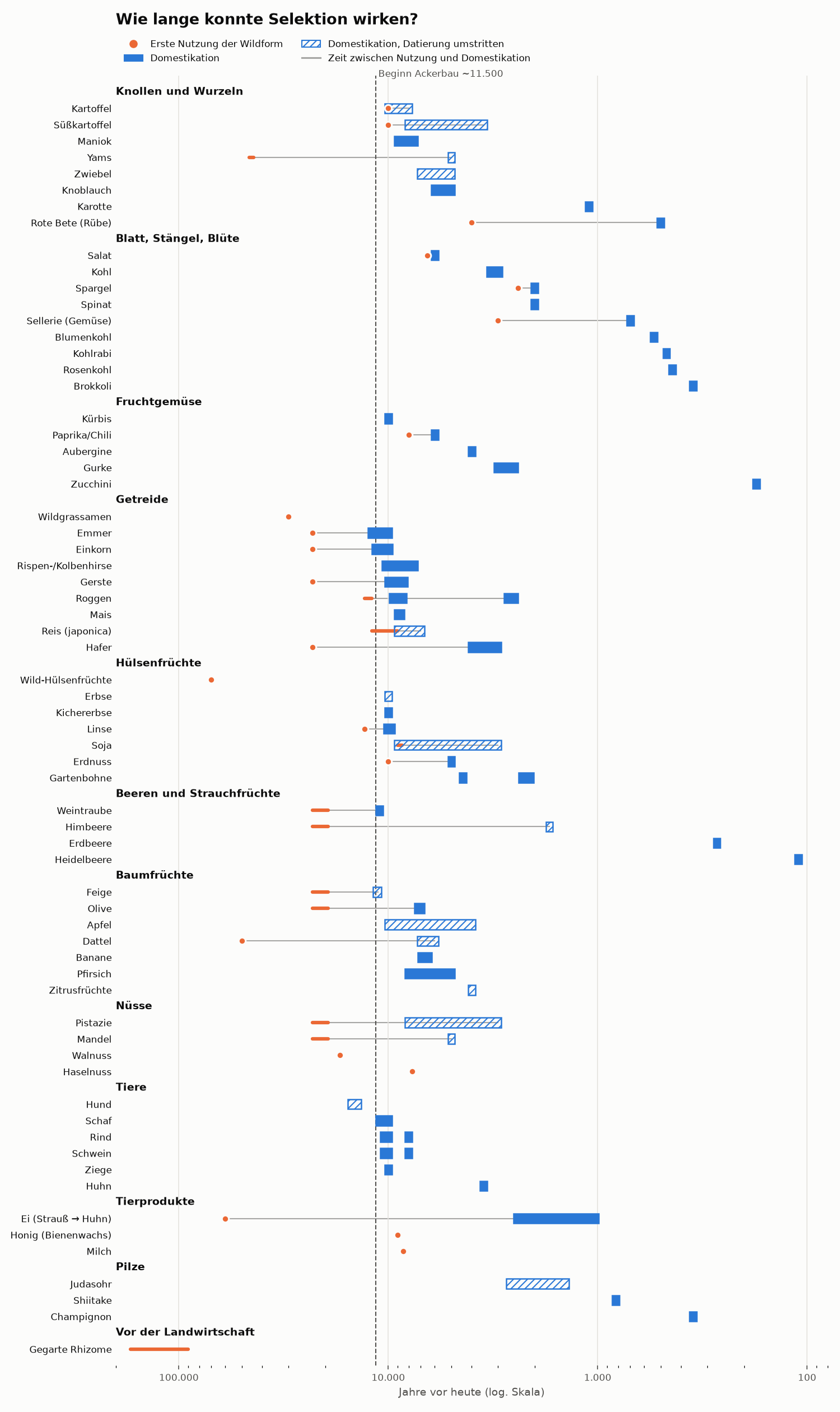
<title>Wie lange konnte Selektion wirken?</title>
<link rel="alternate" href="https://pn.posch.org/blog/domestikation/"/>
<id>https://pn.posch.org/blog/domestikation/</id>
<published>2026-10-08T00:00:00.000Z</published>
<updated>2026-10-08T00:00:00.000Z</updated>
<author><name>Peter N. Posch</name></author>
<summary>Wildnutzung und Domestikation von Lebensmitteln auf einer Zeitachse.</summary>
<content type="html"><![CDATA[<p>Manche Lebensmittel nutzen Menschen seit Zehntausenden Jahren in ihrer
Wildform, andere sind kaum 200 Jahre alt. Die älteste Kartoffelnutzung
im Titicaca-Becken ist über Stärkekörner belegt (Rumold und Aldenderfer
2016), die Walnuss verbreitete sich entlang alter Handelswege wie der
Seidenstraße (<span class="nocase">Pollegioni u. a.</span> 2015).</p>
<div id="fig-zeitachse">
<p><img src="https://pn.posch.org/blog/domestikation/fig-zeitachse-output-1.png"
width="700" /></p>
<p>Abbildung 1: Erste Nutzung der Wildform bis Domestikation,
logarithmische Achse.</p>
</div>
<h2 id="quellen">Quellen</h2>
<div id="refs" class="references csl-bib-body hanging-indent">
<div id="ref-pollegioni2015" class="csl-entry">
<p><span class="nocase">Pollegioni, Paola, Keith E. Woeste, Francesca
Chiocchini, u. a.</span> 2015. „Ancient Humans Influenced the Current
Spatial Genetic Structure of Common Walnut Populations in Asia“. <em>PLoS
ONE</em> 10 (9): e0135980. <a href="https://doi.org/10.1371/journal.pone.0135980">https://doi.org/10.1371/journal.pone.0135980</a>.</p>
</div>
<div id="ref-rumold2016" class="csl-entry">
<p>Rumold, Claudia U., und Mark S. Aldenderfer. 2016. „Late Archaic–Early
Formative period microbotanical evidence for potato at Jiskairumoko in
the Titicaca Basin of southern Peru“. <em>Proceedings of the National
Academy of Sciences</em> 113 (48): 13672–77.
<a href="https://doi.org/10.1073/pnas.1604265113">https://doi.org/10.1073/pnas.1604265113</a>.</p>
</div>
</div>
]]></content>
<rights>CC BY 4.0</rights>
</entry>
<entry xml:lang="en">
<title>A new blog</title>
<link rel="alternate" href="https://pn.posch.org/blog/welcome/"/>
<id>https://pn.posch.org/blog/welcome/</id>
<published>2025-04-24T00:00:00.000Z</published>
<updated>2025-04-24T00:00:00.000Z</updated>
<author><name>Peter N. Posch</name></author>
<summary>It is time for a place to gather info.</summary>
<content type="html"><![CDATA[<p><img src="https://pn.posch.org/blog/welcome/octopus.webp" alt="A regular octopus" /></p><p>It is time for a place to gather info. This is a place for my thoughts and
remarks, feel free to consume at your own risk.</p>
]]></content>
<rights>CC BY 4.0</rights>
</entry>
</feed>